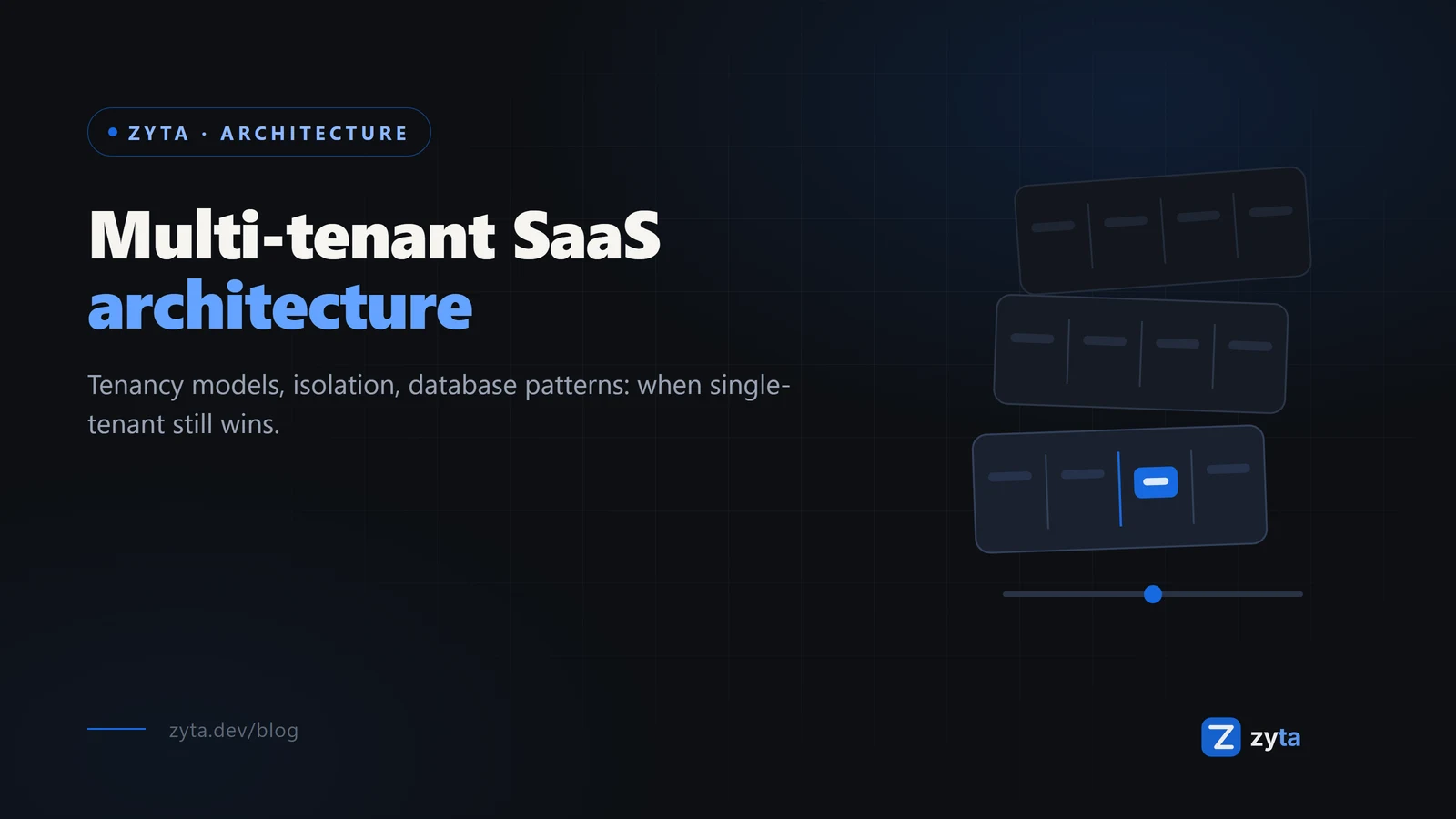
Multi-tenant SaaS architecture is how one product instance serves many customers without cloning the whole stack for each account. For operations teams - people who care about reliability, cost, onboarding speed, and data security - the tenancy model is not an academic diagram. It decides how you isolate tenant data, scale under load, recover from incidents, and explain risk to customers.
This guide explains multi-tenancy vs single-tenant, the main multi-tenant database and isolation patterns, architectural concerns that show up in production, and how to choose the right architecture for an operations-heavy SaaS application.
What multi-tenant SaaS architecture means
In multi-tenant software as a service (SaaS), multiple tenants share application logic and infrastructure while each tenant’s data and configuration stay logically separate. A tenant is typically a company, workspace, or organization - not a single end user.
Contrast with single-tenant architecture: one dedicated application instance (and often a dedicated database) per customer. Single-tenant can simplify isolation and customization; multi-tenant usually wins on cost efficiency, shared infrastructure utilization, and how fast you can onboard a new tenant.
When people ask “is multi-tenancy good for SaaS?”, the operations answer is: it is good when you need scalable multi-tenant growth and shared resource utilization without linear ops cost per customer. It is painful when isolation, noisy neighbors, or compliance require stronger physical separation than your design delivers.
Multi-tenant vs single-tenant: how operations should decide
Use this decision frame when you choose between multi-tenant and single-tenant (or a mix):
| Concern | Multi-tenant (shared instance) | Single-tenant (dedicated) |
|---|---|---|
| Cost & compute utilization | Tenants share infrastructure; better average utilization | Higher idle cost per customer |
| Onboarding | New tenant is usually config + data partition | Provision stack / DB per tenant |
| Isolation | Depends on design (row, schema, DB) | Stronger default blast-radius limits |
| Customization | Feature flags & config; avoid forks | Easier deep custom code (ops debt) |
| Patching & release | One release path for all tenants | Many fleets to upgrade |
| Compliance posture | Prove tenant isolation in shared systems | Easier “your own environment” narrative |
How should you decide between single-tenant and multi-tenant? Start from number of tenants, tiers, compliance, and how much customization sales has promised. Many SaaS platforms use multi-tenant for standard tiers and reserved single-tenant (or dedicated database) for enterprise.
Core multi-tenant architecture patterns
1. Shared application, shared database (row-level tenancy)
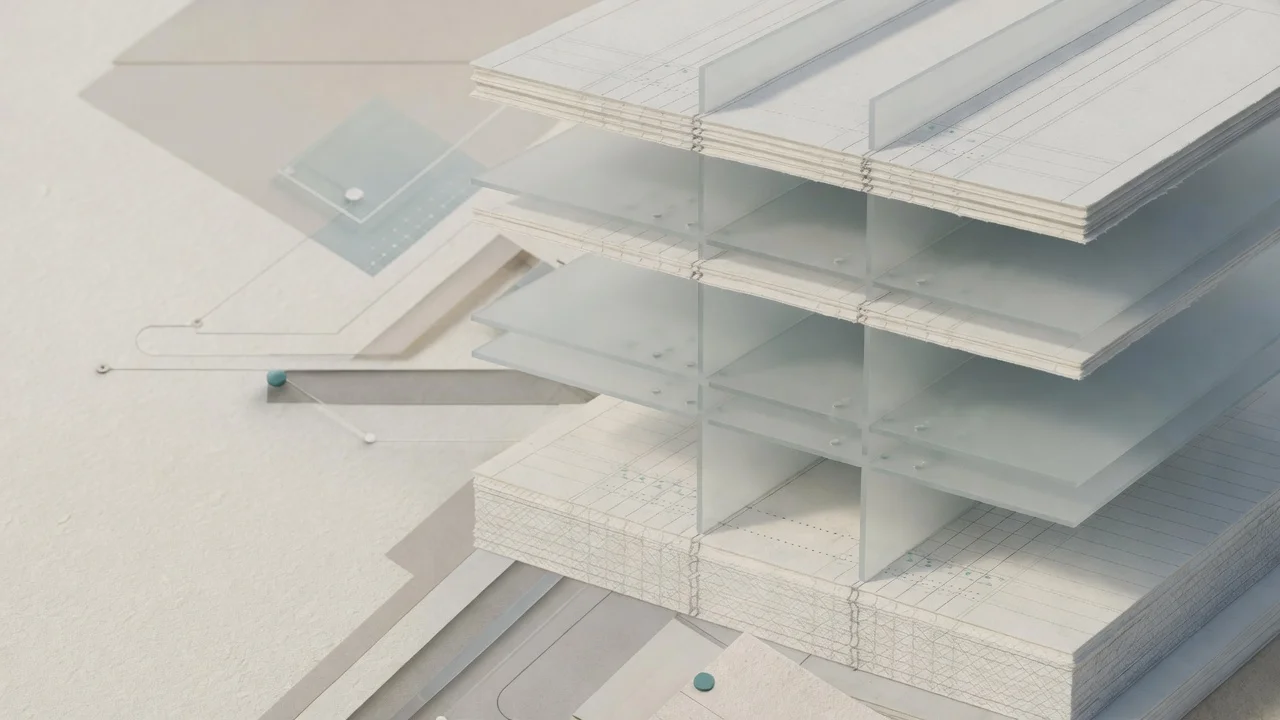
One application instance, one database. Every business table carries a tenant id (or organization id). Queries and writes always scope by tenant context.
- Pros: Highest density, simplest deploy topology, strong cost efficiency.
- Cons: A missing filter is a cross-tenant data leak; performance of one tenant can affect others (noisy neighbor).
- Ops focus: Automated tenant filters, RLS or equivalent, query review, and load tests that model multi-tenant workload.
2. Shared application, schema per tenant
One database, separate schema (or namespace) per tenant.
- Pros: Clearer separation than pure row multi-tenancy; migrations still somewhat centralized.
- Cons: Migration blast radius and connection/schema management grow with tenant count.
3. Shared application, database per tenant
One app tier, dedicated database (or cluster) per tenant - or hybrid: shared DB for SMB, database per large tenant.
- Pros: Stronger data isolation and restore flexibility; large tenants get dedicated capacity.
- Cons: More operational surface - backups, credentials, capacity, and observability per database.
4. Fully single-tenant stack
Separate application instance and data store per customer.
- Pros: Maximum isolation and customization.
- Cons: Weak multi-tenant cost story; release and SRE load scale with the number of tenants.
These patterns map to common multi-tenant database strategies: single database with shared tables, schema-per-tenant, or one database per tenant. There is no universal “right architecture” - only the right architecture for your risk, scale, and product surface.
Architectural concerns in multi-tenant SaaS applications
Teams that only draw boxes for “multi-tenant system” often miss the concerns that burn operations later:
- Tenant isolation and access control, Every API, job, export, and cache key must carry tenant context. Prefer server-side enforcement (policies, RPC scopes) over trusting the client.
- Data isolation and data security, Define what “cannot see another tenant’s data” means under failure modes: bug, misconfigured job, support tooling, analytics warehouse.
- Noisy neighbors, Tenants share compute and I/O. Rate limits, fair scheduling, and per-tenant quotas protect the multi-tenant environment.
- Migrations and schema evolution, One schema serving many tenants needs careful expand/contract; schema-per-tenant multiplies migration complexity.
- Observability, Logs, metrics, and traces should be queryable by tenant without leaking PII across tenants.
- Backup and restore, Shared-DB restore of one tenant is hard; database-per-tenant restore is clearer but heavier.
- Identity, AuthN/AuthZ, SSO, and “user in multiple organizations” must not blur tenant boundaries.
- Customization vs core product, Prefer configuration over code forks so one application instance stays maintainable.
What is an example of multi-tenancy architecture? Think of a B2B operations platform where many agencies and client orgs use one product, each with organization_id (tenant id) on business data, shared application logic, and policies that prevent cross-tenant reads - exactly the shared multi-tenant SaaS pattern with row-level isolation.
Tenant isolation: practical best practices
To ensure data isolation and security in a multi-tenant architecture:
- Tenant context at the edge of every request, Resolve org/tenant once, then pass it through services and jobs.
- Default-deny data access, Lists, peeks, exports, and RPCs filter by tenant; never “load then filter in the UI.”
- Separate secrets and integrations, API keys and webhooks are per tenant; never reuse one customer’s credential for another.
- Cache and search keys, Include tenant id in cache keys, search indexes, and queue payloads.
- Admin and support paths, Impersonation and support tools need audit trails and explicit elevation - not a global super-query without scope.
- Test for isolation, Automated negative tests that attempt cross-tenant ID access should fail closed.
For operations, tenant isolation is a reliability property: a leak is an incident, not a polish bug.
Scaling multi-tenant SaaS applications
Scalability in multi-tenant SaaS is both horizontal scale of the app and fairness across tenants.
- Scale shared compute, Stateless app tiers scale with aggregate traffic; watch per-tenant hotspots.
- Database strategy, Shared DB needs careful indexing on tenant columns; database-per-tenant needs automation for provisioning and monitoring.
- Async work, Queues should not let one tenant’s backlog starve others; partition or prioritize by tenant when needed.
- Capacity planning, Model growth as “number of tenants × usage per tenant,” not only global QPS.
How can I monitor performance and resource usage in a multi-tenant architecture? Emit metrics with tenant labels where safe, track error rates and latency percentiles per tenant tier, and alert on outliers (one tenant dominating CPU, storage, or job depth). Pair that with cost attribution so product and finance see which tenants drive infrastructure spend.
Building a multi-tenant SaaS product: operations checklist
When building a multi-tenant SaaS or evolving an existing SaaS application:
- Pick a default tenancy model for standard customers (usually shared app + shared DB with strict tenant id).
- Document an escape hatch (dedicated DB or single-tenant) for enterprise and regulated deals.
- Automate tenant lifecycle, create, suspend, export, delete - with clear ownership in ops runbooks.
- Gate releases, Feature flags per tenant or tier; avoid all-or-nothing risky launches when possible.
- Practice incident response, Know how to disable one tenant, rotate one integration, or restore one tenant’s data without a full-platform outage.
- Align sales with architecture, Custom one-offs that break the multi-tenant model become permanent ops tax.
Multi-tenant SaaS architecture best practices (summary)
- Prefer one application instance with strong tenant context over many forks.
- Choose database per tenant only when isolation, restore, or noisy-neighbor risk justify the cost.
- Treat tenant isolation as a tested invariant, not documentation.
- Design for scalability and fairness: quotas, queues, and observability by tenant.
- Keep multi-tenant and single-tenant options honest: a hybrid SaaS multi-tenant design is common and valid.
- Optimize for operations: fewer fleets, automated onboarding, clear blast radius.
FAQ for operators and builders
Is multi-tenancy good for SaaS? Usually yes for growth-stage B2B products that need cost efficiency and one release train. Not if every customer requires a hard physical boundary you cannot prove on shared infrastructure.
What are the architectural concerns in multi-tenant SaaS applications? Isolation, noisy neighbors, schema migration safety, per-tenant observability, backup/restore, and identity - before fancy domain features.
How many tenants and tiers will your app support? Answer this early. Tiering (standard vs enterprise) often maps to shared multi-tenant vs dedicated database or single-tenant architecture.
How can I devise a multi-tenant architecture for my SaaS application? Start from data model (tenant id everywhere), enforcement (server-side), isolation tests, and a written decision on shared vs separate database. Expand to schema or DB-per-tenant only with automation.
Closing
Multi-tenant SaaS architecture is a product and operations decision: how tenants share resources without sharing risk. Get tenancy, data isolation, and monitoring right, and multi-tenant SaaS applications scale with clarity. Get them wrong, and every new tenant multiplies incident blast radius.
For teams running multi-tenant operations platforms, the winning pattern is usually a scalable multi-tenant core with explicit isolation guarantees - and a deliberate path to stronger separation when a tenant’s risk profile demands it.